trade_union_toolkit_image

BDS Toolkit for Trade Union Organizers in North America

The BDS Toolkit for Trade Union Organizers is a helpful resource designed to support union organizers in North America working to end their workplaces’s or employer’s complicity in Israeli apartheid and genocide, and working towards building power in solidarity with Palestinian liberation. The toolkit includes various resources, such as a breakdown of BDS in a union context, how to gather evidence of your union’s or employer’s complicity in Israel’s atrocity crimes, how to build a campaign, how to negotiate ethical procurement policies, and of course how to be put in touch with other union organizers in North America organizing for Palestine in their workplace through a BDS lens. For any questions or inquiries about the toolkit or other support needed for your workplace organizing, please reach out to the BDS Movement North America trade union organizer Mona (Mun-na) at [email protected]

How to Use the BDS Toolkit for Trade Union Organizers

This toolkit is intended to be shared with trusted union members and organizers in working to end their workplaces’s or employer’s complicity in Israeli apartheid and genocide, and working towards building power in solidarity with Palestinian liberation within a North American context. 

We strongly encourage anyone using this toolkit to ensure they are a member of a union or established labor formation and use your union power to end complicity. If you aren’t sure which union to join or need support starting a union and are based in the U.S., check out the Emergency Workplace Organizing Committee website and resources here: https://workerorganizing.org/. If you are in Canada, you can look through a list of affiliates with the Canadian Labour Council that can be contacted directly, or get in touch to get help getting into a union. 

If you are a worker in the U.S., we recognize that the path to formal unionization can be difficult given the current state of the National Relations Labor Board and the current administration's attacks on labor. While the infrastructure and institutional power of an established union gives great benefit and stronger impact to your campaign, we encourage non-union workers who don’t see the formal path to unionization as viable to take up alternative modes of power building in the workplace outside of the traditional union route. Many worker formations have already done this in the U.S., such as building coalitions of workers’ assemblies like Southern Workers Assembly or worker-led mutual aid networks and worker centers, such as Make the Road New York. Remember, even without a formal union, concerted activity is protected under the National Labor Relation Act (NLRA) - you have the right to organize with your co-workers to address work-related issues.

This toolkit is a developing resource, so please get in touch for updated versions or for any needed campaign guidance. Also share with us any effective organizing practices that can enrich this toolkit.

We can support organizing for Palestine within your union or workplace by: 

  • Connecting you with the largest coalition of Palestinian civil society, including Palestinian trade unions. 
  • Connecting you with other trade union partners and organizers who have successfully pursued BDS campaigns globally (including in Europe, Africa, South America, etc.)
  • Strategizing with you on the most effective way to organize and build campaigns in your workplace or union. 
  • Offering advice on intersectional coalition building.
  • Helping coordinate actions with partner organizations.
  • Uplifting your organizing on social media.
  • Working with you to turn your research and workplace mapping into a strategic campaign.
    • Note: Clear goals and good research is the foundation of any successful campaign but goals and research alone are not a campaign. Campaigns involve strategy, pressure tactics, coalition building, media, etc. We can work with you to develop a campaign strategy!

If you want support with your workplace or union campaign, please reach out to the BDS North America Trade Union Organizer at [email protected].

Why We Organize for Palestine in Our Workplace

The Palestinian labor movement, almost entirely represented in the BDS movement, is united in calling on workers globally to support the Palestinian struggle for freedom, justice and equality.

As is commonly said in the labor movement, an injury to one is an injury to all. Israel’s ongoing genocide against Palestinians in Gaza with the complicity of western powers has hastened the onslaught of a “might makes right” era that threatens humanity and working people at large. This has manifested itself in the collapse of respect for international law, human rights and workers’ rights.

Today, the Palestinian struggle for justice is at the heart of the battle against a world order of “might makes right” that is being imposed by the U.S-Israel genocidal axis and enabled by European colonial powers. As Israel’s wars of aggression against the peoples of the West-Asia/Arab region expand from Lebanon to Syria and from Yemen to Iran, and as the US threatens the peoples of Cuba, Greenland, Venezuela, among others, it is clear that hardly anyone is safe from this might-makes-right descent to the abyss. Simultaneously, Israel is continuing its genocide in Gaza and accelerating its brutal ethnic cleansing, annexation, settler violence, and violence against our prisoners in the West Bank. This affects us all and therefore should unite us all. The struggle for justice in Palestine is inseparable from the global struggle against systemic racism, exploitation, climate devastation and all forms of oppression.

The consensus in the Palestinian Labor Movement calls for:

  • Upholding all Palestinian rights as stipulated in international law – at a minimum an end to the military occupation and apartheid as well as respecting the right of Palestinian refugees to return and to reparations;

  • Ending direct and indirect complicity in Israel's regime of genocide, apartheid and military occupation.


Solidarity begins with ending complicity. 


As Palestinian trade unions have written repeatedly, “Israel is only able to continue its livestreamed genocide against Palestinians, including daily massacres, burning our children, men and women alive, or starving and thirsting them to death, due to the ongoing complicity of states, companies and institutions around the world.” 


As union members in North America and especially in the U.S. - the number one partner in Israel’s crimes - we have a moral, legal, and financial obligation to end complicity in grave human rights violations and international crimes, including genocide and apartheid. 


As trade unionists and workers in North America, we have an obligation to support the calls from the Palestinian people for boycotts and divestment in solidarity with their struggle for freedom, and to most immediately cohere and coordinate our organizing efforts in order to advance a comprehensive arms embargo demand. 


Why an arms embargo demand?

As Palestinians continue to face a U.S.-armed Israeli genocide and occupation, a comprehensive military embargo on Israel is the most important urgent demand to organize around in the United States and broader North America. Major labor unions across the U.S. and Canada now adopt a military embargo position, reflecting the majority of the public supporting this demand. A June 2026 Pew public opinion poll shows that 65% of Canadians and 60% of Americans hold negative views of Israel. 

It is now our task as workers connected to institutional power to bring this demand into being by: pressuring our unions to:

  • Adopt a public military embargo position that is reflective of the support among the rank and file, 

  • Act on that position by ending complicity through ending contracts or activities that directly or indirectly support Israel’s atrocity crimes, and 

  • Adopt ethical procurement policies and, where applicable, ethical investment policies that exclude corporations implicated in grave human rights violations anywhere, including in Palestine. 

The U.S. is the primary supplier of Israel’s arms and military funding, making the U.S. labor movement uniquely positioned to mobilize pressure towards enacting a comprehensive military embargo. 

Endless militarism and coordinated assaults on Palestinian workers heavily impact working people in North America. In both Canada and the U.S., our public and private sector pension funds are investing billions of dollars of our hard-earned savings in weapons, high-tech (including militarized Artificial Intelligence), security, and surveillance companies complicit in the killing and oppression Palestinian workers. 


Aside from the large and unconditional military funding Israel receives from U.S. taxpayers, the U.S. has also spent tens of billions of US taxpayer dollars since October 2023 to wage military actions primarily on behalf Israel or at its behest. Some credible estimates put the cost of the US war on Iran, to fulfill Netanyahu’s 40-year-old dream, at more than $100B at the time of writing, excluding indirect costs. A prominent Harvard expert on war budgeting expects the total cost of that war alone to reach at least one trillion dollars. Trump is asking for half a trillion dollars more for the Pentagon, at a time when many working families cannot afford their energy, transportation, health, education and grocery bills.


As workers who bear the brunt of global systems of violence, we must reject hyper-militarization and fight for an end to working people’s resources being funneled into endless wars. And that starts with a comprehensive military embargo against apartheid Israel. 

What Does Workplace Complicity Look Like?

Note: it is important to distinguish your union’s complicity from your employer’s complicity. For example, your employer might be complicit in Israel’s occupation, apartheid and genocide of Palestinians via business dealings or contracts with companies that are invested in or partnering with the Israeli government or military (such as auto manufacturing companies contracting with Israel to provide auto parts used for military, prison, and police purposes). This then becomes a question of how to use your union as a vehicle (via contract negotiations, resolutions, amendment adaptations, etc.) to pressure your employer to cut contracts with complicit companies. If your union is complicit (such as having pension funds or bonds invested in or partnering with the Israeli government or state-owned enterprises, for example in the form of Israel bonds, or in companies that are enabling Israel’s genocide), then it becomes a matter of pressuring your union leadership to divest from such complicit investments and to pass robust ethical investment resolutions at the local and national level. How to pass a resolution is covered in another section of this toolkit. 
Types of Complicity 

Example

Directly or indirectly manufacturing or transporting weapons or weapon components (including dual-use items) intended for Israel. 

Longshoreman, tugboat operators, and truck drivers (where they are unionized),  as well as construction and maintenance workers, and un-unionized tech workers, all work for complicit companies along the supply chain that facilitates genocide and apartheid in Palestine.

Providing union support to candidates or elected officials who are supporting/enabling Israel’s crimes. 

Anti-Palestinian lobbying group AIPAC and its many affiliates have for decades used election donations to influence the vast majority in the U.S. Congress to unconditionally and uncritically support apartheid Israel. Providing union support to AIPAC-backed officials and candidates is an act of complicity. 

Investments in or from Israeli firms which finance military occupation, genocide, destruction of Palestinian homes and construction of illegal settlements.

The UAW holds up to $1 million  in Israeli bonds and securities, which directly finances Israel’s illegal military occupation, apartheid and genocide of Palestinians. 

Investments in companies that are complicit in Israel’s crimes. 

Public pensions in New Jersey are invested in Palantir, which is complicit in atrocity crimes by working with Israel to test their surveillance technology and militarized AI weapons on Palestinians.  

Direct or indirect trade agreements, partnerships, and deals with Israel or Israeli government bodies and institutions (such as the Histadrut,  Israel's colonial trade union federation).

The Canadian government has expanded the Canada-Israel Free Trade Agreement, applying Israeli custom laws to products produced in illegal settlements in the West Bank thereby contravening international law. 

Providing financial, intelligence or digital services to complicit entities.

Companies like Google and Amazon are complicit in Israel’s war crimes via contracts like Project Nimbus, the companies’ $1.2 billion dollar cloud computing contract with the Israeli government and military.

Purchasing, stocking or advertising services/products of complicit companies that are priority BDS targets.

Stocking Coca-Cola, which has a regional distribution center in an illegal Israeli settlement in occupied Jerusalem, helping entrench Israel’s military occupation. 

Breaching the academic or cultural boycott of Israel by hosting, supporting or attending Israeli arts or sporting events.

Academic collaboration in arms research that directly or indirectly enables Israel’s illegal occupation.


Co-sponsoring or funding a film festival that screens Israeli state-funded films


A union pension fund that holds investments in a company sponsoring a UEFA tournament — in which Israeli club Maccabi Tel Aviv is participating — could be considered to be indirectly supporting the event in breach of the cultural boycott.

Anti-Palestinian racism and bias in coverage relating to the Israel’s Gaza genocide, apartheid, and other grave human rights violations.

Western media, including The New York TimesBBCCNN, among others, consistently report with anti-Palestinian racism and bias - such as reprinting lies from Israeli officials, withholding amended coverage, or directing reporters to avoid terms like “slaughter”, “ethnic cleansing,” and “occupied territory.”

Silencing solidarity with Palestinians in the workplace and targeting pro-Palestine employees.

The Screen Actors Guild–American Federation of Television and Radio Artists (SAG-AFTRA) guild members who spoke out in support of Palestine have faced “blacklisting,” job loss and harassment for their stance. 

How to Gather Evidence of Your Union’s or Employer’s Complicity in Israel’s Atrocity Crimes

  • Compile research on your union or company’s complicity

    • To start, see if Who Profits or the American Friends Service Committee (AFSC) has evidence of your employer’s complicity in the Israeli occupation, apartheid or genocide.

    • In the U.S., you can check out your union’s DOL financials, where unions must report all their investments, to find out what companies/bonds your union is invested in. 

    • To look up union financials in Canada, you can check your union's official website or contact it directly for their financial statements, as unions are required to provide this information to their members. Union financials are typically available through their annual reports or specific financial disclosures.

    • If you have access to information about sales/contracts with Israeli companies or the Israeli government, acquisitions of Israeli companies or donations to complicit institutions (ex: Friends of the IDF), document and record it. 

Make sure to read the BDS corporate complicity criteria resource for a deeper breakdown of how to build your research and campaign around complicit targets.

Companies risk being complicit even if they have not directly participated in or benefited from a specific international crime. Continuing business-as-usual relations with the mere knowledge that the crime was occurring or that there is a credible risk of its occurrence may be sufficient to generate complicity.

Listed below are a number of non exhaustive examples and questions pertaining to sectors that are central in enabling and maintaining Israel’s unlawful military occupation (including the wall, colonial settlement enterprise, forcible displacement, home demolitions, etc.), apartheid regime, and the commission of the crime of genocide. Participation in these activities implies a high degree of complicity.

  • First, Military - Security: Is your union or employer implicated in: 

    • The sale, transfer, or diversion of arms, munitions, and other military or security equipment to Israel (including Artificial Intelligence, cloud services, other technological infrastructure, and dual-use items)?

    • The purchase of military or security material from Israel, including spyware, or conducting joint military training with it or its organs? 

    • Conducting joint military-security research with Israel or with its complicit universities?

    • The sale or purchase of surveillance and identification equipment? 

    • The supply of security services, equipment, and materials to enterprises operating in the illegally occupied territory or enforcing apartheid? 

  • Second, Technology & EnergyIs your union or employer implicated in:

    • The provision of, among others, transport, telecommunications, technological solutions (cloud services, database technologies, AI, etc.), or other services and utilities supporting the maintenance of the regime of military occupation and apartheid or the commission of the crime of genocide?

    • The extraction and use of illegally acquired Palestinian natural resources, in particular water, land, and energy, for business purposes?

    • The sale or transfer of energy, gas, oil, and coal that is essential for the commission of the crimes of genocide and apartheid and the maintenance of Israel’s illegal military occupation, including the settlements?

  • Third, Construction/Destruction, Infrastructure & Environmental Crimes: Is your union or employer implicated in:

    • The supply of equipment and materials facilitating the construction and the expansion of settlements, the wall, and associated infrastructure of the regime of military occupation and apartheid? 

    • The supply of equipment for the demolition of Palestinian housing and property, the destruction of agricultural farms, greenhouses, olive groves, and crops, particularly in Jerusalem, the Jordan Valley, and Al-Naqab (Negev)? 

    • Pollution and the dumping of waste in or its transfer to illegally occupied Palestinian territory?

  • Fourth, Banking, Finance, & Captive Markets: Is your union or employer implicated in:

    • Banking and financial operations, including loans for housing, infrastructure, and the development of businesses, that help to develop, expand, or maintain settlements or any other aspect of the regime of occupation and apartheid? 

    • Insurance for projects, companies, and activities that are part of or enable Israel’s crimes?

    • The use of benefits and reinvestments of enterprises owned totally or partially by settlers for developing, expanding, and maintaining the settlements or any other aspect of the occupation? 

    • Captivity of the Palestinian financial and economic markets, as well as practices that disadvantage Palestinian enterprises, including through restrictions on movement and administrative and legal constraints, including by pharmaceutical, water, electricity, and other companies?

  • What partnerships does your union or employer have with complicit Israeli companies?
  • Does your union or employer have contracts or sales with Israeli governmental bodies? These include:
    • Military/Security
    • Police
    • Land Authority
    • Population and Immigration Authority (among others)
  • Does your union or employer maintain racist (anti-Muslim, anti-Palestinian, Anti-Arab, etc.) internal policies? Such policies/practices may include:
    • Matching donations to anti-Palestinian or racist organizations
    • Discriminatory practices
    • Internal repression or consequences for organizing

Has your employer or union purchased Israel Bonds, or does your union have any pension fund investments in complicit companies at the local, state, or national level? 


Has your employer sold software, servers, or constructed physical infrastructure in Israel or the Occupied Palestinian territories?

Does your employer service settlements (settlements are a war crime under international law and settlements in the West Bank are illegal under international law and Israeli law)

  • What services are provided to these settlements?
  • Are the parts your employer manufacters or technology your company provides/sells being weaponized, used for illegal purposes and/or or enabling other crimes against humanity (genocide and apartheid)? 
    •  Ex: Building, assembling, or transporting weapons or weapon components, Google and Amazon’s cloud services with Project Nimbus, mass surveillance using Palantir technology or Cisco’s Webex equipment, etc.
  • Be sure to specify how your employer manufacturers weapons/weapons components and/or sells their technology knowing it will be deployed in illegal ways. To do this, consider how Cisco worker’s Open Letter exposes how Cisco knew their technology would be used to enable human rights violations by grounding your research in international law. 
    • For example, Cisco not only built an apartheid government tech hubs– Cisco knowingly built tech hubs in illegal settlements, which are a war crime under international law, implicating Cisco.  
  • How does X policy/technology/product/service violate international law? 
  • How does X policy/technology/product/service violate your company’s own policy? 
  • If you claim that X policy/product/partnership “oppresses” Palestinians, what kind of oppression? What are the material implications? How can you be more specific?
  • Always quantify your research when possible 
  • Include dates and numbers associated with sales/contracts/pensions/ acquisitions

Use Cisco workers’ Open Letter as an example of how to compile and organize your research. Your research does not necessarily have to be in the form of an open letter, but use Cisco workers’ letter as a guide.

Mapping Your Workplace

Power Mapping 

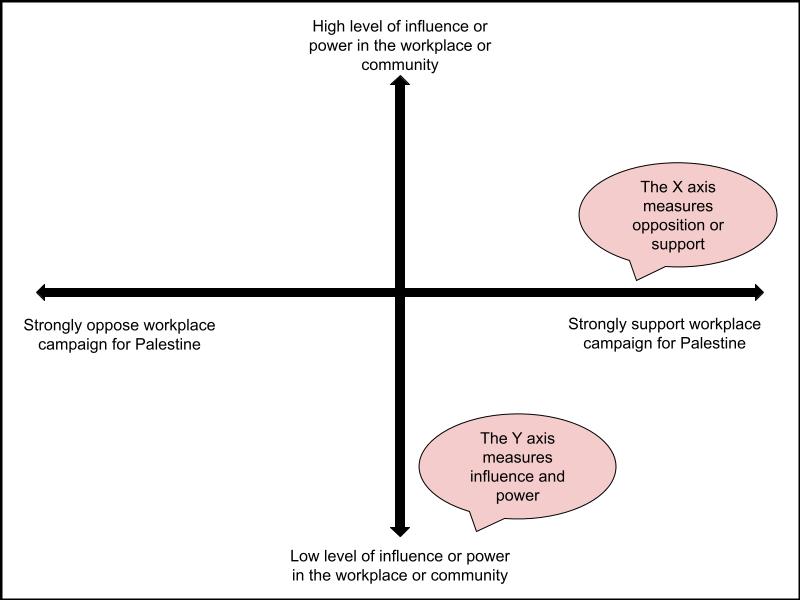
Power mapping is an important starting point to organizing in your workplace. We use power maps to understand, analyze and consider everyone who might be involved, supportive of, or opposed to your workplace campaign and the power they might hold over achieving change. The power map tool below is a helpful place to start for all campaigns, whether mapping public decision makers or having a better understanding and visual tool for your own workplace.

For workplaces you will want to think about fellow union members, but also consider supportive managers, board members, people with useful campaign experience, or workers or community members who hold a lot of influence in a particular location or role.


Mapping Workers and Members 

When organizing in the workplace for Palestine and beyond, you will want to have an understanding of density and activity of workers or members, along with what issues are widely and deeply felt among workers. This will help you better understand how much groundwork is needed, what areas of education workers may need about the issue you are campaigning on, how to make solidarity connections with issues that most deeply resonate with workers and intersect with their demands, and how to mobilize support for future tactics. 

Many workers and members may show interest in your campaign, but keep in mind that for some workers this may be a new area so it is our job to help workers take strategic action and educate new members via political education and leadership skills development. 

  • Workplace mapping can help you and your campaign better understand:
    • How many workers are covered by the union?
    • How many workers are active members in the union?
    • How many workers are sympathetic to your campaign?
    • Where are the gaps in union presence (departments, shifts, sites, sectors)?
    • When each worker/member has been supportive or willing to take action on a particular issue. 
    • When workers or members were last contacted about the campaign.
  • Remember:
    • Think intersectionality! Are there other people who are dissatisfied with company policies (related or unrelated to Palestine) who can be brought into your campaign if we raise a common demand?
    • Think beyond just people in your department (build power across class divides and positions).
    • Invite people into this work whenever you can! Mapping is continuous and tedious work, many people need that nudge, and the more the merrier so the workload doesn’t fall on a handful of workers. 

Building a Campaign

Building a campaign group or team in the workplace will help sustain your work and lead to a more effective campaign and more impactful wins. Taking the time to build a committed base of activists and leaders to carry through the campaign is a crucial task that can’t be short-cut: campaigns are patiently and strategically built, not discovered or suddenly developed!

We also know that employers can be hostile towards Palestine solidarity campaigns, particularly in workplaces with the highest level of complicity. Organizing in a collective and under the banner of the union will give you a greater level of protection than as individuals.

Effective groups will: 

  • Be representative across departments, the rank-and file, and job grades. 
  • Share responsibilities to avoid burnout or individuals being targeted by employers. 
  • Utilize existing resources to develop campaigns. 
  • Prioritize calls from Palestinian civil society, focusing on targeted boycott and divestment campaigns to end complicity–a moral duty. 
  • Meet regularly to keep up momentum and establish clear communication within the group. 

Examples of roles and responsibilities of group members: 

  • Coordinator: Organizes activities, liaises with union officials for support (and protection).
  • Recruitment and 1-1 Lead: Organizes one to one meetings with reps and members.
  • Communications Lead: Manages workplace updates and campaign messaging, including on social media (strategic messaging discipline is important).
  • Action Coordinator: Plans and tracks campaign actions. 
  • Department/hub leads: Individuals in each department or hub/sector/chapter who support sharing information and organizing.

Once you have identified areas of complicity in your workplace, focus on achievable but worthwhile goals. Even small wins in the workplace, if strategic, can build towards the goal of dismantling apartheid. So although we want to deliver big, meaningful change, we have to start with smaller campaigns and build towards the bigger challenges as we grow in strength. Incremental, sustainable wins are important in all campaigns.

Example Starting Issue 

Example Goal 

Workplace stocking Coca-Cola, an organic and grassroots boycott target as set by the BDS movement.

Agreement from management to not stock Coca-Cola, and eventually work towards an ethical procurement policy negotiated with your union or employer reps.

Escalating ICE violence in the workplace or community.

Agreement from management to have a plan to protect workers in the face of ICE violence, and asking for the employer or union to disclose any relevant investments or contracts with complicit companies - such as the tech company Palantir which provides ICE with surveillance technology. 


Each campaign will look different with varying goals and targets depending on your specific context. Another helpful tool in developing specific, context-sensitive campaign goals, targets, and timeline is the Midwest Academy Strategy Chart.

Campaigns are more effective when there is robust evidence of a target’s complicity. By honing in on a target that may already have existing research and resources, you are contributing to a broader campaign and therefore strengthening people power. Additionally, if you have existing meetings between your workplace management and the union, these are a good place to raise questions about potential areas of complicity, i.e. contracts with complicit companies, their value and duration. 

Here are some helpful tools on how to gauge complicity and target selection:

When you have mapped your workplace, identified issues you want to change and carried out research into your workplace complicity, you will need to start building a campaign strategy. 

You can prioritize your campaign’s focus on one or more targets, but in order to keep the message clear, it is probably best to emphasise one target when spreading the message of your campaign. This is completely up to you and your group to decide, depending on the context of your campaign and strength of the union in your  workplace.

Some example questions to think about when planning your campaign with your campaign group:

  • What specific demands do we want to make of our employer? What do we want? Who within the organization can deliver this, and who has the power to make the change we want to see?
  • What resources do we already have, and what resources do we need? Can we approach our union leadership branch for funding/support officers for advice? Do we need help developing campaign materials? Who else, inside or outside of our union structure, can help give us resources we need?
  • How will we communicate our campaign to members? Do we already have communication structures in place, are they up to date? What methods are most effective for our members? What on-ramps can we develop to bring more members in?
  • How will we protect members and support them? Have we consulted with our union? Have we sought advice from movement or supportive lawyers (usually pro bono)? Do we anticipate our employer to target pro-Palestine employees, and do we have the power to escalate action to defend our members if needed? What legal resources do we have?
  • What does a campaign win look like? How will we measure this? Are we prepared to compromise, and if so where? What are our redlines? How will we evaluate the campaign?

Regularly reviewing and evaluating your campaign are an essential part of building worker power and effective Palestine solidarity campaigns in the workplace, something we often forget to make time for. Before jumping into your next action or mobilization, it’s important to allocate some time for reviewing and debriefing the current state of your campaign with your campaign group. 

  • Revisit your campaign goals: 
    • What was the goal of the campaign? How far are you from reaching this goal?
  • How did you achieve these changes?
    • Assess the ways in which the campaign was impactful, consider which tactics worked well, and which tactics didn’t work so well. Look back on your campaign action timeline, identify key turning points in the campaign and whether these were linked to specific tactics you used. Example: a very well attended members meeting or management concessions and/or acknowledgement of the demands of your campaign.
  • What lessons have you learned?
    • Consider as a group which lessons you’ve learned from the campaign. If you were to do it again, is there anything you would do differently? 
    • Which messages resonated with members the most? What actions might you want to take in the future to continue building on your impact?
  • Identify challenges:
    • If you have faced challenges, opposition or unexpected problems, consider how this might change how you allocate resources next time. 
    • You may want to consider recruiting more people to your campaign group, reviewing the roles you initially created and reaching out to your union or community for additional resources and support (if applicable).
  • Communicate and celebrate your impact:
    • After a wave of actions and mobilizations in a campaign, take time to communicate wins to your supporters and members and thank them for taking action. The struggle for Palestinian liberation and an end to complicity is a long one. It's important that we acknowledge the work of members who have taken action with you along the way, encourage them to stay motivated and let them know about next steps for the campaign.

Tactics to Pressure Your Union or Employer to End Complicity


*Consult with local legal representatives when planning actions. 


Boycott, Divestment, and Sanctions (BDS)

“B” in BDS: Boycott campaigns against carefully selected priority targets cut ties with and withdraw support from complicit Israeli institutions and companies as well as international companies that support Israel’s violations of international law.

  • Example: You can organize your union institution to become apartheid free (Apartheid Free Zones). AFZ’s commit to cutting all ties with apartheid Israel and all its complicit institutions, as well as with corporations that are implicated in its gross human rights violations. 


“D” in BDS: Divestment campaigns withdraw investments from, block re-investment in, and/or exclude from contracts complicit Israeli and international companies that support Israel’s violations of international law. 


“S” in BDS: Lawful and targeted sanctions campaigns pressure governments and intergovernmental institutions (UN, FIFA, etc.) to abide by their duties under international law to not aid in Israel’s human rights violations and atrocity crimes. 

  • Local governments can pass resolutions calling on their States to take action for accountability. For example, a city resolution may call for an arms embargo (ending military funding to and military-security trade with Israel, as well as transit of military supplies to it) and to follow and enforce existing law. Example passed by Northampton, MA (US) city council November 2024. 


Other BDS demands and tactics reflected in the 2026 Palestinian Trade Union May Day Call:

  1. Adopting ethical procurement policies (EPP) and, where applicable, ethical investment policies (EIP). These intersectional policies exclude corporations implicated in grave human rights violations anywhere, including in Palestine.
  2. Peacefully disrupting* and blocking the transfer of military, energy and other dual-use supplies to Israel, by:
    1. Participating in actions to identify and stop the illegal transfer by sea, land or air, including by pressuring states to enforce international obligations in relation to such shipments, and by pressuring complicit corporate actors.
    2. Refusing to handle Israeli or Israeli-bound military supplies, energy and other dual-use cargo.
  3. Declaring your union an Apartheid-Free Zone (AFZ) to end corporate and institutional complicity with systems of oppression, particularly Israel's regime of apartheid and genocide against the Palestinian people.
  4. Escalating* economic, academic, cultural, and sports BDS campaigns.
  5. Cutting all ties with Israel’s colonial Histadrut labor federation and expelling it from all international fora. The Canadian Labour Congress (CLC), Canada’s equivalent of the AFL-CIO, recently voted to cut ties with Histadrut. 

*Please refer to the “Legal Resources and Disclaimers” section of this toolkit to better understand what your specific legal context is before taking up these actions in your workplace. 


Letters, Petitions, and Resolutions

Workplace letters, petitions, and resolutions are ways to build consensus among union members, demonstrate that there is wide support for your campaign, raise awareness of pro-Palestine campaigns and a method for agreeing allocation of resources to support a workplace campaign. These tools may not have a big impact on the decision making of our employers or union leadership, but they are important stepping stones and part of union and workplace democracy. 


When writing a letter, petition, or resolution:

  • Keep your demands clear and concise, with clear targets chosen (i.e. to specific managers, city council members or bodies, shareholders, your union executive board, etc.) and avoid unnecessarily inflammatory language (consult with texts that have already proven to be effective elsewhere).
  • Use your union, workplace, and community networks to amplify your letter, petition, or resolution. 
  • When trying to pass a resolution in your union, make sure you understand the bylaws and parliamentary procedures within your specific union and local context. 
    • It is also strategic to build up intersectional support within your workplace for your resolution to have a better chance of passing, whether that’s within your local or on a state or national union level. 
    • Explore what’s possible on the local, state, and national level when it comes to passing resolutions or making constitutional amendments. 
  • Decide whether your letter or petition will be exclusively for union members or open to all concerned staff members and/or community members. 
  • Notice/announcement boards, lunch time meetings, break rooms, etc. are great ways to collect large numbers of signatures for your petition in a short period of time. 
  • Petitions allow you to build up a database of potentially interested contacts: this would allow raising awareness directly, sharing significant campaign updates, and informing the supportive workers of opportunities to get more directly involved with your campaign. It also allows for sharing any leadership development opportunities. 
  • Remember open letters, petitions, and resolutions are tactics, but they shouldn’t be the primary tactic of your campaign. 
  • Keep in mind these tactics may spread quickly through the workplace and may pick up outside attention. Ensure that they concisely and accurately describe what your campaign is about and why it is important, in order to avoid being misrepresented. 
  • These tools can be both physical and digital. Think about which format is most accessible to people in your workplace. 


Example Resolutions:


Example Divestment Letter: Palantir U.S. Divestment Letter Template


Workplace or Community Days of Action*

*Consult with local legal representatives when planning actions. 


Days of action are a way to build up momentum behind your campaign and secure specific commitments from your members to support the campaign. 


Make sure to fill out this form in order to be put in touch with other union locals in North America planning workplace and community days of action for Palestine.


Ideas for workplace or community days of action:

  • Hold a lunch time walkout or photo action to show your solidarity with Palestine and highlight your campaign’s demands. 
  • Circulate petitions and letters with your coworkers drawing attention to your workplace campaign and any calls to action. 
  • Organize union meetings, teach-ins or film screenings to raise awareness of the plight of the Palestinian people. 
  • Promote upcoming national demonstrations and mobilizations and commit to attending with coworkers and community members. 
  • Hold lunch time letter writing sessions to your local councils calling on them to divest local funds from arms and companies enabling apartheid, occupation, and genocide. (Keep in mind that local contexts vary– an engagement strategy with local councils in one city or state may look quite different in another city or state.)
  • Host a fundraising event for Palestinian trade union mutual aid funds and to cover your campaigns necessary expenses. 


Make sure you collect contact information for new members and attendees to help build the campaign. It’s helpful to have sign-up sheets and follow up with a thank you and next steps. 


Negotiating Ethical Procurement Policies

To ensure our workplaces uphold international labor standards and human-rights principles in their operations, partnerships, and investments. 


When a company’s policies, suppliers, or investments are connected to human rights abuses, the crimes of genocide, apartheid and ethnic cleansing, workers have both the right and the responsibility to demand transparency and ethical conduct. 


When making demands for ethical procurement agreements within your workplace, remember to: 

  • Ground wording in international law and universal human rights. 
  • If you are not sure of the level of complicity, call for an ethical sourcing investment review and actions to address any identified areas of complicity. 
  • Include a demand for commitment to future transparency; this could be a call for the disclosure of suppliers, investment partners, and contracts to your trade union reps to review. 
  • Emphasize that employees have a stake in how their employer operates. 
  • Push for union involvement or representation on future ethical investment committees or decision-making bodies.


Often, employers will want to avoid breaking a contractual agreement with a complicit company early if there is likely to be a cost associated with it. Be prepared for this and consider negotiating with your employer for an early exit or committing to not re-sign – remember, incremental and strategic wins are better than no wins! An example of a successful campaign that won a commitment to not renew their contract with a complicit company - giving them time to find viable alternatives as the contract expires - was New York City’s public hospital system announcing that it would not be renewing its contract with Palantir following grassroots pressure.

Some workplaces already have some form of “socially responsible/ ethical investments” policy on investments and procurement. It’s worth looking through the policy and discovering if there are points they are violating through their ties to Israel, because clearly investments in Israel while knowing that it is perpetrating war crimes, crimes against humanity and genocidal violence are not socially responsible. Using the company's own policies, words, and past declarations to hold it to account can be a very powerful tool.

That being said, sometimes we cannot fully rely on the socially responsible policies of companies or ESG (Environmental, Social, and Governance) ratings for ethical funds. A good example of this is following DBIO pressure, major Belgian bank Argenta Bank completely divested from Palantir, and KBC and Degroof Petercam partially divested on March 19, 2026. This win is significant because Belgian banks manually divested from Palantir because ESG ratings from data providers considered Palantir a “socially responsible” investment, despite the company’s role producing military and surveillance technologies. Arnaud Denis, a bank spokesperson said, “Even though the stock has not been systematically excluded by external sustainability lists, we are of the opinion that it has no place in ESG portfolios.” ESG ratings are, in part, influenced by the Israel lobby which pushes for certain companies to be included in ethical funds based on the civilian applications of their militarized dual-use technologies. A company such as Palantir that openly admits its tech is used to kill people and champions the unregulated militarization of technologies has no business in an “ethical” fund, yet ESG ratings failed to filter one of the companies most passionately committed to supplying tech for human rights violations. 

Communications, Protection, and Member Meetings

Developing a communication strategy for a workplace campaign is important for an effective campaign as well as for protecting your members from a hostile employer.


  • Always check your recognition agreement, union or employment contract for specifics on what your protections are and what is and isn’t allowed on company time. 
    • Usually unions with workplace recognition agreements will have written into the recognition terms around communications with wider staff, but employers should not dictate the content of communications with your members. The agreement will also usually include reference to which facilities union reps may have access to (e.g. Zoom, Slack, etc.). This is more complicated for campaigning in workplaces without recognition, as your employer will likely obstruct any communication on their systems relating to Palestine. Remember some of the best tools we have are one to one conversations with our colleagues and in person meetings. Signal groups can also be quite helpful and relatively more secure. 


  • Set up organizing spaces, agree on group expectations, and inoculate. 
    • For your campaign or organizing team, it is wise to set up a group chat away from your employer's systems, e.g. a Signal chat, so that you can keep discussions around your campaign private and secure. Make sure you get the consent of your group members before adding anyone to this, and discuss expectations and conduct. Specifically, you will want to agree to confidentiality and data protection in line with your union policies, alongside a clear agreement to keep these spaces focused on workplace organizing, rather than general link sharing and news updates, as this can lead to people becoming disengaged.


  • Public communications and protecting yourself at work
    • Most employment contracts prevent staff from publicly campaigning or disclosing information about the employer. For example, if you were posting about your employer's complicity or financial information on social media this would likely result in retaliatory/disciplinary action being taken against you by your employer. We strongly encourage union organizers to focus on internal communications, and any public communications about the issue be overseen and distributed by your trade union or trade union caucus, rather than members of staff of the company or organization, to give you protection.

Regular and consistent member meetings for your campaign can help keep up momentum, help your campaign goals remain clear and achievable, and help keep members activated and engaged. A few things to keep in mind when planning for and holding member meetings:

  • Give enough notice for your members meetings: for maximum attendance get creative with advertising the meetings, using posters on notice boards, have 1-1s and send email outs to get the word out. 
  • Have an agenda for the meeting: setting a draft agenda (to be amended and adopted by the participants in the meeting) before the meeting will give members a clear expectation about what to expect and will help the meeting stay on track. 
  • Share speaking responsibilities among the campaign group to communicate: a team of people sharing research, information, minute taking and setting out a campaign plan is more likely to get a positive response from members than just one person talking. 
  • Build relationships: giving people a chance to introduce themselves briefly will help them to feel more comfortable about being involved and help them to recognize their power in the union. 
  • Make sure that your group is both inclusive internally, and welcoming to new people externally: avoid cliques or language which is not accessible to new members to the campaign. Give as much space as feasible to everyone to express their views and suggestions.
  • Regular meetings are important to keep up the momentum. Ensure these are structured and link to past meetings/action points. Short and frequent are more engaging for members! 
  • Highlight opportunities for people to get involved “upfront” and behind-the-scenes with campaigning so that people can be involved in different ways.
  • Provide an opt-out option to your members: Unfortunately, some members might not support your campaign. One way to avoid complaints about your work in the workplace is to provide an opt-out clause from communications on Palestine, which you can then point to in the future should your management seek to use this as an issue.

Strategic Radicalism, Ethical Principles, and Incremental Wins

Strategic radicalism calls on the movement to strive to be simultaneously principled and strategic (goal-oriented) by, for example, employing multiple tactics that take local contexts into account to mutually build on and amplify each other. A strategic and incremental win for one workplace or union is a win for all.

With all that is taking place, there is an emerging debate and constructive critique around strategies, which are healthy and needed to hold each other accountable to the collective principles and goals of the BDS movement, and to reconcile ethical principles with strategic effectiveness in any given context. Unhelpful public accusations, on the contrary, can undermine or fracture our movement.

With BDS representing the broadest Palestinian civil society coalition, including most of the labor movement, and given the diversity of tactics used by organizers, activists, and workers in the labor movement, we would like to outline a simple path of strategic radicalism to move forward collectively. This notion is based on the BDS movement’s tried-and-tested operational principles:

  • Gradualness (incremental process of building power to affect policy change)
  • Sustainability (defending and building on previous achievements by steadily widening support for them)
  • Context Sensitivity (being sensitive to the particularities of every context without losing track of the overall movement objectives)

Strategic radicalism in this moment requires us to consider the following:

  • Divestment and military embargo are and must remain the primary goals of labor movements in solidarity with Palestine, particularly in the U.S. However, these goals will not be met in a few months, given the dominating power structures and nature of investments in the Israeli state. We must achieve reasonable gains that can be continuously built on and reestablish our new positions. The only path to justice is an incremental, strategic approach with patience and ethical commitment.
  • Each workplace or union has its own context with varying resources, membership, histories of activism, leadership composition and relations, workplace grievances, union structure, Zionist entrenchment, and rank and file activation. What is possible in one union or workplace may not be possible in another. As such, we should recognize that power comes from a diversity of tactics that keep the overall goal in mind. 
  • The longer-term goal of ending all complicity in Israel’s regime of settler-colonial apartheid and military occupation and the immediate need for ending the genocide in Gaza are both important. Similar to what happens in labor organizing campaigns or in bargaining sessions, union groups have to make tough decisions on what is achievable now versus later, and whether currently negotiated agreements allow us to build on them later. Regardless of the path, in all our solidarity movement actions and statements, we must always center Palestinians, Palestinian rights, and the absolute urgency of ending the genocide in Gaza. This is a priority even as we push for long-term divestment and military embargo. They are not mutually exclusive.
  • Coordination and communication across our movement and across unions is important, and it is even more necessary when deciding to escalate or negotiate agreements and policies. This is both to understand each other's context in order to prevent public attacks and factionalizing, and to amplify cohesive messaging that can energize our movement. We are all working for Palestinian liberation, including the right of refugees to return. This is a time to unite around the Palestinian people’s demands and the Palestinian Unions' May Day Call that the overwhelming Palestinian grassroots networks, coalitions, and organizations call on solidarity movements to adopt.

We must continue to build rank-and-file power and amplify each other’s voices and efforts. Multiple fronts, different contexts, a diversity of strategic and principled tactics - but one struggle for return, justice, and liberation from the river to the sea.

Wherever you’re organizing, we encourage adopting strategic radicalism as a theory of change.

Stay in touch

Make sure to fill out this form in order to be put in touch with other union organizers in North America organizing for Palestine in their workplace through a BDS lens. BDS is the largest solidarity movement with Palestinian liberation that is active in over 120 countries, and representative of the vast majority of Palestinian trade unions.

Form